
Better by Design: A Framework for More Circular, Functional and Convenient Packaging
Better by Design: A Framework for More Circular, Functional and Convenient Packaging
Packaging design has a powerful role to play in reducing waste, lowering environmental impact and improving performance across the value chain. That’s why Graphic Packaging developed Better by Design — a framework that guides packaging innovation toward solutions that are more circular, more functional and more convenient than the alternatives they replace.
Critically reviewed by Ramboll, a global consultancy with more than 18,000 experts creating sustainable solutions for governments and companies worldwide, the framework is supported by independent validation.
Ramboll concluded that the Better by Design framework, underlying circularity assessment methodology and calculation tools developed by Graphic Packaging, is solid and transparent in providing a science-based comparison between an innovation and the applicable market benchmark.
Better by Design helps packaging teams evaluate innovation through three connected lenses: circularity, functionality and convenience. It:
- Identifies measurable improvements versus incumbent packaging
- Highlights trade-offs early in the design process
- Supports science-based comparisons using transparent methodology
- Applies across concept development, prototyping, piloting and production
Designing Packaging for a Circular Economy
According to the Ellen MacArthur Foundation, around 80% of a product’s environmental impact is determined during the design phase. For packaging, early design decisions can influence material use, recyclability, carbon footprint, product protection and consumer acceptance.
Better by Design builds on Design for Environment principles, but takes a broader view. It evaluates whether a packaging innovation delivers measurable improvements across three connected dimensions: circularity, functionality and convenience.
Together, these dimensions support Graphic Packaging’s Better by 2030 Driving Circularity goal, which requires every new product innovation to demonstrate at least one positive differentiator in each area compared with the incumbent packaging.
What “Better by Design” Measures
The Better by Design framework assesses packaging through metrics selected according to the product, market and use case. This helps generate objective proof points, support transparent comparisons and highlight trade-offs early in the innovation process.
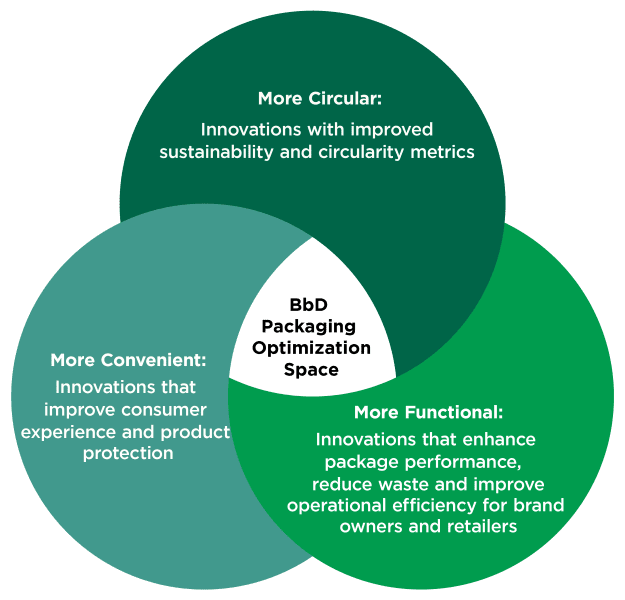
More Circular
- Materials and impact: Packaging weight, renewable/recycled/plastic content, carbon footprint
- End-of-life performance: Recyclability, actual recycling rates, Material Circularity Indicator
- Evidence base: International standards, detailed compositional data, relevant regulatory requirements
More Functional
- Product protection: Sealing integrity, drop and impact and compression resistance, barrier performance
- Operational performance: Filling efficiency, stackability, pallet stability, operational efficiency, compatibility with packaging or filling requirements
- Brand and retailer needs: Print quality, shelf impact, fitness for purpose across the value chain
More Convenient
- Consumer experience: Ease of opening, resealability, portability, ease of disposal
- Usability and safety: Tamper-evidence, product visibility, clear communication of product information
- Adoption at scale: Design features that help consumers use and dispose of the pack correctly
Why Better by Design Matters for Packaging Innovation
Packaging innovation often involves trade-offs. A solution may weigh more than the incumbent pack but deliver a lower carbon footprint, better recyclability or stronger product protection.
Better by Design helps teams compare these factors systematically, so decisions are based on evidence rather than isolated metrics.
Better by Design in Practice: ProducePack™ Punnet Tray
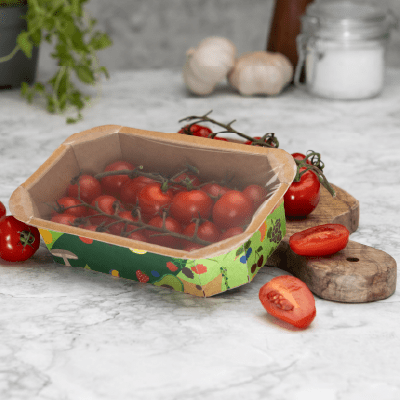
The framework can be seen in action through the ProducePack™ Punnet tray, a paperboard alternative to virgin PET trays for fresh produce in representative EU markets.
The analysis showed that the paperboard punnet delivered positive results across the most important circularity, functionality and convenience metrics for this type of packaging.
- Lower cradle-to-gate carbon footprint compared with the PET benchmark
- Higher renewable content and no plastic content in the tray itself
- Improved design for recyclability and a significantly higher Material Circularity Indicator
- Strong functional benefits, including improved shelf-life performance for cherry tomatoes and the potential to reduce product loss across the value chain
- Independent testing found that grape and cherry tomatoes packed in paperboard punnets had a longer shelf life than those packed in plastic trays
- For consumers, the pack provides a printable surface for information and branding, while a transparent lid helps maintain visibility of the produce
Designing Better Packaging, From the Start
Better by Design is being integrated into Graphic Packaging’s innovation process from the earliest concept stage through prototyping, piloting and production.
By applying the framework throughout development, teams can make informed design choices, validate performance and build stronger value propositions for customers.
As sustainability knowledge, regulations and tools continue to evolve, so too will Better by Design. Its purpose remains clear: to support packaging solutions that meet customer needs, improve consumer experience and contribute to a more circular packaging value chain.
Read the full Better by Design eBook to explore the complete methodology, detailed metric categories and ProducePack™ Punnet analysis in more depth:
Download Now
Related Resources
eBook
Unwrapping PPWR Legislation: What’s Next for Healthcare Packaging?
October 22, 2025
Discover how the Packaging and Packaging Waste Regulation (PPWR) is driving change in healthcare packaging.
eBook
A Comparative Assessment of the Shelf-Life of Tomatoes in Paperboard and Plastic Punnet Trays
June 25, 2024
Do paperboard punnet trays for fresh produce applications deliver an equivalent shelf-life to traditional plastic punnet trays? This study conducted by Washington State University set out to determine just that.
Article
Advancing Circularity, Functionality, and Convenience in Fresh Protein Packaging: The Award-Winning Sainsbury’s PaperSeal™ Shape Tray
December 17, 2025
The PaperSeal™ Shape tray, developed for Sainsbury’s and Pilgrim’s Europe, won multiple product innovation awards in 2025 for innovation and sustainability.